

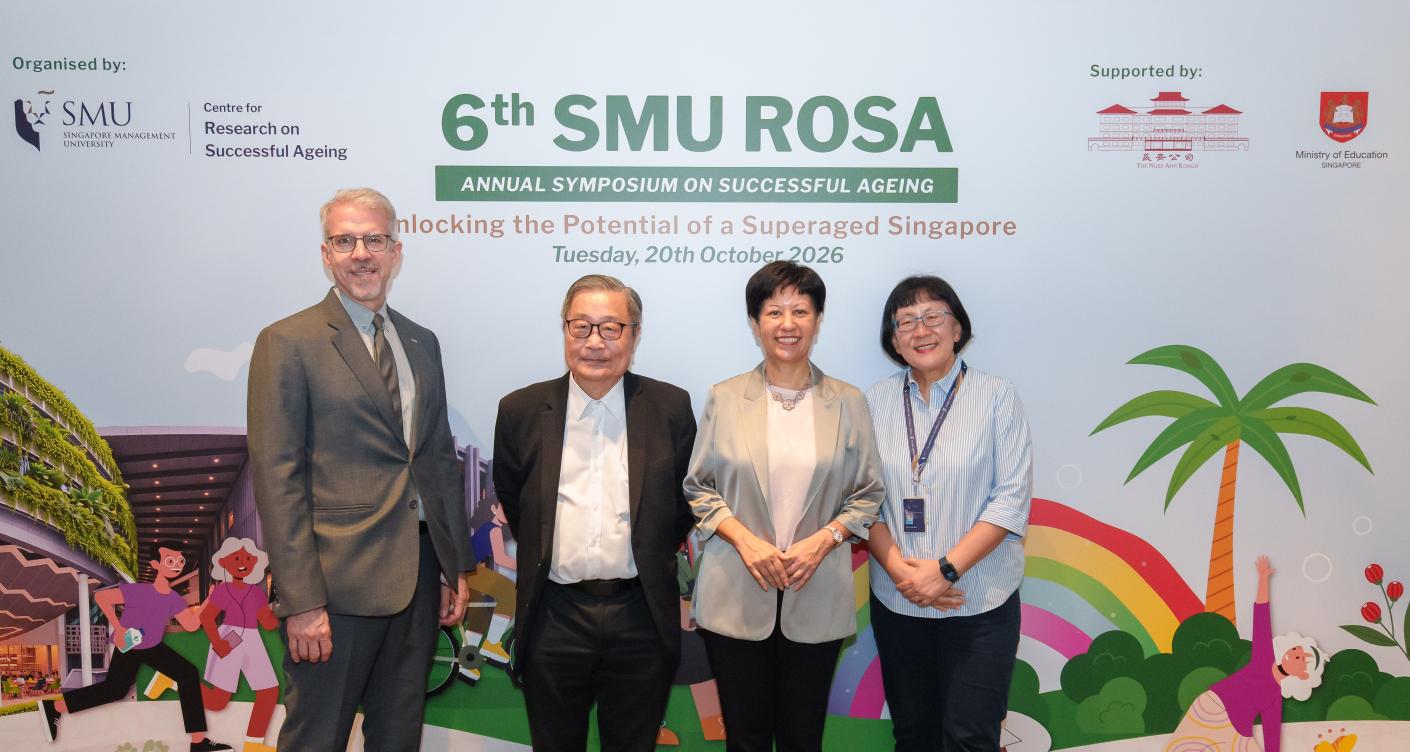
6th SMU ROSA Annual Symposium on Successful Ageing


On 20 October 2026, ROSA held its 6th Annual Symposium on Successful Ageing at SMU Hall, bringing together more than 250 participants from government, academia and industry. Under the theme “Unlocking the Potential of a Superaged Singapore”, the symposium explored how age-friendly environments, preventive health, financial planning and community support might turn longevity into a societal advantage. Presentations examined financial preparedness for retirement, social engagement among older couples and cancer screening under Healthier SG. A panel discussion then brought Minister Indranee Rajah together with academic experts from Germany and Japan, moderated by ROSA Director Professor Paulin Straughan.
WELCOME ADDRESS

Professor Kenneth Benoit, Dean of the School of Social Sciences, SMU, opened the 6th ROSA symposium with a welcome address. He highlighted that while Singaporeans are living longer, a gap of about 11 years remains between life expectancy and healthy life expectancy1. It is therefore important to fill these extra years with health, purpose and quality. He outlined the areas the symposium would explore: preventive health, family and social ties, neighbourhoods that support ageing in place, individual capacity, and financial resilience. Professor Benoit emphasised that individuals, communities and government each play a role: individuals bring agency, communities offer mutual support, and government provides the infrastructure, so that longevity can become a societal strength.
GUEST OF HONOUR ADDRESS

Ms Indranee Rajah, Minister in the Prime Minister’s Office and Second Minister for Finance and National Development, delivered the Guest of Honour address2. She noted that Singapore has entered a new demographic phase as a super-aged society3. Calling longevity one of the nation’s greatest achievements, she asked what must be true for it to become an advantage rather than a strain. She said the advantage depends on whether the extra years are lived in good health, and on whether seniors are prepared early enough. She outlined three areas to build a “longevity society”:
- Healthy and active longevity: Singapore has shifted from treating illness to promoting well-being. This happens through Healthier SG, the expansion of Active Ageing Centres and community health posts, and more community and home-based care options for seniors with care needs.
- Age-friendly neighbourhoods: Making homes and neighbourhoods safer and more accessible supports ageing in place. Examples include Enhancement for Active Seniors (grab bars, ramps, slip-resistant flooring), the Silver Upgrading Programme, Friendly Streets, and the Age Well Neighbourhoods pilot.
- Resilience across the life course: Preparing for longevity must start early, in health, finances and skills. Examples include SkillsFuture’s mid-career support for Singaporeans aged 40 and above.
She cited ROSA’s research on ageing in place and Project Silverlight, which found that seniors who are connected to their communities have higher well-being. Such evidence helps policymakers deploy resources wisely and move beyond assumptions.
DISCUSSION SESSION

Minister Indranee was joined by Professor Ursula Staudinger, Rector of Technische Universität Dresden, and Professor Satoshi Shimizutani, Vice Dean of the Graduate School of International Development, Nagoya University, for a panel discussion on “Transforming Longevity into Societal Advantage”. The panel was moderated by Professor Paulin Straughan, Director of ROSA.
Professor Staudinger opened by saying the goal should be better lives, not just longer ones. She noted that genetics explain no more than about 30% of differences in healthy ageing. This leaves much room for individuals and society to shape how people age, beginning with healthy habits taught from kindergarten.
Work came up repeatedly in the discussion. Professor Staudinger observed that monotonous routines act as “poison” for the brain, while varied challenges protect against cognitive decline. The panel also discussed more flexible forms of work, such as breaking jobs into smaller pieces or shorter periods. These could suit retirees who wish to keep contributing at a gentler pace, while helping workplaces cover absences as more employees take caregiving and parental leave. Professor Straughan added that workplace ageism starts early, with people in their 40s already reporting fewer training opportunities. more employees take caregiving and parental leave, retirees who still wish to contribute meaningfully, at a gentler pace, are well placed to backfill these absences.

Turning to financial and long-term care preparedness, Professor Shimizutani shared that nearly 80% of Japanese aged 60 to 64 are financially prepared for retirement. Those facing a shortfall tend to keep working. Japan’s mandatory long-term care insurance, funded by premiums from everyone aged 40 and above, now faces rising costs and a severe shortage of care workers. For Singapore, Minister Indranee highlighted support in the form of CPF, MediShield Life and CareShield Life. Cohort-based packages such as the Pioneer and Merdeka Generation Packages. Taking a more preventive approach, Healthier SG encourages people to build healthy habits from age 40, helping to keep healthcare costs down later in life.
Responding to an audience question on how happiness and purpose can be measured, Professor Staudinger suggested that happiness in later life is closely tied to a sense of purpose. It can be measured by looking at how people spend their time and contribute at each life stage. She highlighted a positive trait unique to later life: seniors have greater resilience in facing challenges, such as declining health or building a new life after work, while remaining content. Echoing the importance of purpose, Minister Indranee closed the discussion by urging everyone to live well by staying healthy, staying connected and finding purpose.

PRESENTATIONS
Am I adequately prepared for old age? Financial preparedness for retirement in Japan, by Prof Satoshi Shimizutani, Vice Dean, Graduate School of International Development, Nagoya University

Professor Shimizutani presented his research on how well Japanese near-retirees aged 60 to 64 are financially prepared for retirement. He measured this by whether all the income they would have after retirement could sustain their consumption just before retiring.
Key findings include:
- Slightly less than 80% of near-retirees are adequately prepared, and this has stayed stable in recent years.
- Public pensions and other transfers make up about 80% of older adults’ available resources. Most of the remaining shortfall is covered by wage earnings, which suggests that many continue working past retirement age.
- About one in five near-retirees lack adequate resources. Their shortfall is estimated at a quarter of their target consumption after retirement, so policies should not focus only on the “average” picture.
- People with more education are better prepared. Women are better prepared than men, but only those with a spouse, which points to women’s financial dependence on their spouses.
During the Q&A, when asked about ageism in Japan, Professor Shimizutani noted that many older people want to work but employer demand remains low. The government has introduced job-matching efforts, and part-time work for older adults is more common in Japan than in China or South Korea.
Do Spouses Change Together? Social Engagement in Later Life, by Asst Prof Cheng Cheng, Assistant Professor of Sociology, Singapore Management University

Assistant Professor Cheng Cheng examined whether spouses’ social engagement changes together over time. She used Singapore Life Panel® data from 1,046 married couples, collected from 2019 to 2025. Social engagement covered visiting friends or family, religious activities, group activities, physical activities and hobbies.
Key findings include:
- Husbands’ and wives’ overall social engagement scores track each other closely over time.
- One spouse’s past engagement is linked to the other’s later engagement, over and above each person’s own habits.
- This link runs in both directions, from wife to husband and from husband to wife, and holds across different activities.
- In some activities, a spouse’s engagement may matter most when the individual is less engaged than usual.
She concluded that efforts to support older adults’ social participation should consider the couple, since a spouse can help sustain a partner’s engagement.
Social Connections, Early Detection: Advancing Cancer Screening Through Healthier SG, by Prof Paulin Straughan, Director and Principal Investigator, ROSA

Professor Straughan unveiled ROSA’s new study, “Who encourages screening? Examining family, friendship and other drivers of health screening participation in later life”. The study analysed data from 7,139 Singapore Life Panel® participants aged 50 to 79. It examined whether they reported regular cervical, colorectal and breast cancer screening at intervals consistent with recommended guidelines.
Key findings include:
- Enrolment in Healthier SG was associated with more regular cancer screening. Friends may support this pathway by encouraging Healthier SG enrolment.
- Friendship networks were directly associated with regular screening for breast, cervical and colorectal cancer in most of the groups examined. Family influence appeared to operate more through knowledge and attitudes towards screening.
- Knowledge about screening and fatalistic beliefs were associated with regular screening. These are not entrenched and can be shaped by family, friends and engagement with Healthier SG.
- Those in their 60s showed more pathways to regular screening, possibly because cancer risk becomes more salient at this age.
Professor Straughan noted that advice from peers of the same age is likely to be more impactful, as they are going through similar health challenges. Because people tend to befriend those like themselves, curating informal “third spaces”, such as hawker centres turned into neighbourhood kitchens, can help bridge social divides and strengthen preventive health.
CONCLUSION
The ROSA team would like to extend our heartfelt gratitude to our Guest of Honour, Minister Indranee Rajah, for gracing our symposium this year. We would like to express our heartfelt thanks to The Ngee Ann Kongsi for supporting ROSA’s research through the years. We would also like to thank Professor Kenneth Benoit, Dean of the SMU School of Social Sciences, for his support of ROSA’s work and for delivering the welcome address, and our esteemed guest speakers and panellists for their enriching presentations and discussions. Last but not least, we would like to extend our appreciation to all our colleagues, students, guests and Singapore Life Panel® members who contributed meaningfully to the discussions, without whom our event would not have been successful. For those who would like to revisit the key moments, the symposium highlights can be viewed here.
This event was made possible with the generous support of The Ngee Ann Kongsi.
As always, please reach out to rosa@smu.edu.sg should you have any queries about this event or future ones!